Cardiac Arrest vs Heart Attack: What Every Indian Must Know to Save a Life
India loses over 28,000 lives to sudden cardiac arrest every single day. A heart attack strikes an Indian every 33 seconds. And the most heartbreaking part? Most of these deaths happen in front of family members, colleagues, or bystanders who did not know what to do – or worse, did not know what they were witnessing. That moment could be your father after a heavy meal at a family function. Your colleague mid-presentation. Or you, climbing stairs at your office. This guide is written for every Indian who wants to know the difference – and be ready when it matters.
They Are Not the Same Thing
This is the most important sentence you’ll read today: a heart attack and a cardiac arrest are two different emergencies, and they require different responses. Confusing them is not just a knowledge gap. It is a dangerous one.
What Is a Heart Attack?
Think of your heart as an engine that needs constant fuel. The coronary arteries are the fuel lines. A heart attack – medically called a myocardial infarction (MI) – happens when one of those fuel lines gets blocked, usually by a blood clot forming over a ruptured plaque buildup. The engine is still running. But part of it is being starved of oxygen, and every minute counts. The longer the blockage stays, the more heart muscle dies permanently. The heart does NOT stop beating during a heart attack. What makes this particularly alarming for Indians: research consistently shows that Indians develop coronary artery disease earlier than their Western counterparts. Early consultation with an interventional cardiologist and timely diagnosis through coronary angiography or angioplasty can help detect blockages before they become life-threatening.
Warning Signs of a Heart Attack
In both men and women:
- Squeezing chest pain or a heavy pressure – often described as “haathi baith gaya seene pe” (an elephant sitting on the chest)
- Pain spreading to the left arm, jaw, neck, or upper back
- Shortness of breath, especially with mild exertion
- Cold sweating, nausea, or dizziness
- Persistent heartburn-like discomfort that doesn’t respond to antacids
Women may additionally experience:
- Unusual and sudden fatigue
- Discomfort between the shoulder blades
- Jaw or neck pain without chest tightness
- A vague, unsettling sense that “something is not right
“In our emergency department at Healing Hospital, we regularly see patients – especially middle-aged Indian men – who delayed coming in because they thought it was gas or acidity. That delay can cost you irreversible heart muscle. Never self-medicate and wait. Come in.” – Healing Hospital, Chandigarh
What Is a Sudden Cardiac Arrest?
Cardiac arrest is not a plumbing problem – it’s an electrical failure. The heart’s internal electrical system suddenly short-circuits, causing it to quiver uselessly (ventricular fibrillation) instead of pumping blood. The heart doesn’t slow down – it effectively stops. Blood flow to the brain ceases within seconds. Without immediate action, brain damage begins in 4–6 minutes. Death follows shortly after. Unlike a heart attack, cardiac arrest strikes without any warning. The person collapses, becomes unresponsive, stops breathing, and has no detectable pulse. Sadly, in most Indian households, the instinct is to “sprinkle water on the face” or “give water to drink” – both of which waste precious seconds.
Warning Signs Before A Cardiac Arrest
These may appear seconds to minutes before collapse:
- Sudden dizziness or blackout
- Sudden, unexplained palpitations (dil ki dhadkan tez hona)
- Extreme weakness out of nowhere
- Then: sudden collapse, no breathing, no pulse
Cardiac arrest is a leading killer of young Indian men aged 30–50, including those who appear outwardly fit.
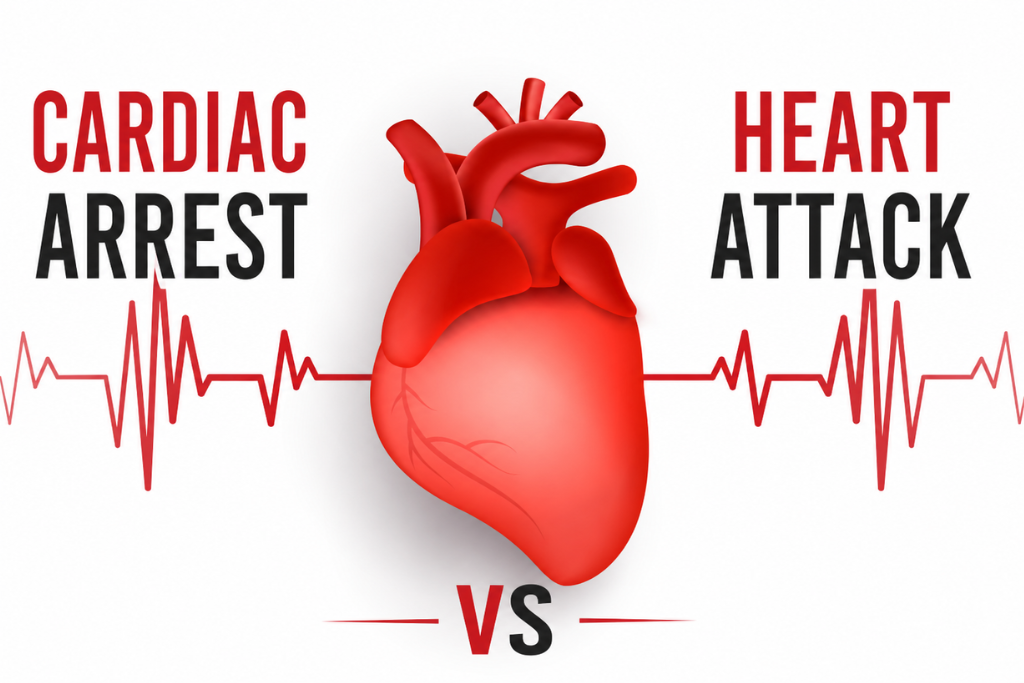
The Core Difference – At a Glance
| Section | Heart Attack | Cardiac Arrest |
| Cause | Blocked artery (blood flow problem) | Electrical malfunction |
| Heart beating? | Yes | No |
| Conscious? | Usually, yes | No – collapses immediately |
| Symptoms | Chest pain, jaw pain, sweating | Sudden collapse, no pulse, no breathing |
What to Do?
If You Suspect a Heart Attack:
- Keep the person seated and calm – loosen their collar, tie, or dupatta
- Do not give water, food, or home remedies
- The patient can be given aspirin 300 mg, atorvastatin 80 mg, and pantoprazole 40 mg.
- Do not perform CPR unless the person loses consciousness and stops breathing
- Call an ambulance and take the patient to the nearest emergency centre at a hospital.
If You Suspect a Cardiac Arrest:
- Tap their shoulders firmly and call their name loudly – check for response.
- Begin hands-only CPR immediately – place both hands in the center of the chest and push hard and fast (100–120 times per minute)
- Call an ambulance and take the patient to the nearest emergency centre at a hospital.
Why are Indians at a Disproportionately Higher Risk?
This is not just a lifestyle problem – there is a genetic component too. Indians have a higher predisposition to:
- Small, dense LDL particles that clog arteries faster
- Central obesity (belly fat) even at lower BMIs
- Insulin resistance and Type 2 diabetes – India is the diabetes capital of the world
- High lipoprotein(a) – a genetic risk factor common in South Asians
- High-salt, high-ghee, refined carbohydrate diets – dal makhani, white rice, maida, namkeen
- Sedentary desk jobs with little structured exercise
- Chronic stress from financial pressure, family obligations, and long working hours
- Heavy smoking and tobacco use (bidi, gutka, cigarettes)
- Untreated hypertension – called the “silent killer” because millions of Indians have it without knowing
Survival and Recovery
After a Heart Attack: In India, the ideal treatment window is within 90 minutes of symptom onset (called door-to-balloon time). The sooner you reach a cardiac catheterization lab for angioplasty, the better the outcome. Delaying because of traffic, family discussions, or “let’s wait and see” costs lives. Modern angioplasty and stent procedures performed by experienced cardiologists in Chandigarh can rapidly restore blood flow to the heart muscle and significantly improve long-term survival and recovery. After Cardiac Arrest: Survival rates for out-of-hospital cardiac arrest in India are estimated below 5% largely because bystander CPR rates remain very low. Survivors often receive an Implantable Cardioverter Defibrillator (ICD) and require ongoing care from specialists in cardiac electrophysiology and heart rhythm management.
The Indian Heart-Healthy Lifestyle Prescription
You don’t need to give up Indian food entirely. You need to make smarter choices:
- Eat smart: Reduce maida, sugar, and fried snacks. Add more sabzi, dal, fruits, and whole wheat roti. Cut down on packaged namkeen and mithai
- Move daily: A 30-minute brisk walk after dinner – start there
- Quit tobacco in all forms: Bidi and gutka are just as dangerous as cigarettes, if not more
- Manage stress: Yoga, meditation, and adequate sleep are not luxuries – they are cardiac medicine
- Know your numbers: Get your blood pressure, HbA1c, lipid profile, and BMI checked every year – especially after age 35
The Bottom Line
In India, where ambulance response times can be unpredictable and bystander CPR awareness remains low, your knowledge and your courage in that moment can be the only thing that stands between life and death. Learn hands-only CPR. Teach your family. Save a life. At Healing Hospital’s Advanced Cardiac Centre, our team of interventional cardiologists and cardiac emergency specialists is available 24×7 – equipped with state-of-the-art cath labs, electrophysiology units, and a dedicated cardiac ICU. Because your heart cannot wait, and neither can we. Experiencing chest pain, breathlessness, or dizziness? Do not wait. Call Healing Hospital’s Cardiac Emergency Line at +91-9464343434.
Frequently Asked Questions (FAQs)
Q1. How to differentiate between a heart attack and a cardiac arrest in a patient near me?
A heart attack is caused by a blocked artery – the heart keeps beating but is starved of blood. Cardiac arrest is an electrical failure – the heart stops beating entirely. Both are emergencies but need different responses.
Q2. Can a heart attack cause cardiac arrest in Indians?
Yes. A severe heart attack can trigger a dangerous arrhythmia leading to cardiac arrest. This is one reason why the patient must be taken to a nearby hospital as quickly as possible after symptoms begin.
Q3. Why are Indians near me more prone to heart attacks at a younger age?
A combination of genetic factors (such as high Lp(a) and insulin resistance), dietary habits, stress, and sedentary lifestyles make South Asians vulnerable to coronary artery disease a decade earlier than Western populations.
Q4. Is it safe to give water or lemonade to a heart attack patient?
No. Do not give anything by mouth during a cardiac emergency. Keep the person still and calm, and focus entirely on getting them to the hospital fast.
Q5. What to do if a family member of a friend complains of sudden chest pain?
In case of emergency, if the patient complains of chest pain that radiates to the left arm and is sudden and sharp in nature, he can be given aspirin 300 mg, atorvastatin 80 mg, along with pantoprazole 40 mg and he/she shall be taken to the nearest medical centre.
Q6. What is the emergency number for cardiac emergencies near me?
Dial 112 (national emergency) or 108 (ambulance in most states). In some cities, hospitals like Healing Hospital have dedicated cardiac emergency helplines, call Healing Hospital’s Advanced Cardiac Centre Helpline at +91-9464343434 to arrange an ambulance for early intervention.