World Mosquito Day 2026: Date, History and a Complete Guide to Malaria and Vector-Borne Disease Awareness
Every year, millions of people worldwide are affected by mosquito-borne illnesses such as malaria, dengue, chikungunya, and Japanese encephalitis. While many of these diseases are preventable, they continue to place a significant burden on public health, particularly in tropical countries like India.
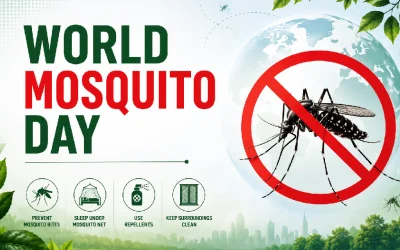
World Mosquito Day, observed annually on August 20th, commemorates one of the most important discoveries in medical history, ‘the finding that mosquitoes transmit malaria’. The discovery, made by Sir Ronald Ross in Secunderabad, India, in 1897, revolutionized the understanding of infectious diseases and laid the foundation for modern mosquito control and malaria prevention strategies.
This comprehensive guide explains the history and significance of World Mosquito Day 2026, India’s progress in reducing malaria, the growing burden of dengue and chikungunya, common symptoms of mosquito-borne diseases, preventive measures, and when you should seek medical care for persistent fever.
Quick Facts:-
- Date: August 20th, observed every year.
- What it commemorates: Sir Ronald Ross’s landmark discovery in 1897, made in Secunderabad, India, proving that female Anopheles mosquitoes transmit malaria between humans.
- Historical significance: This breakthrough transformed the understanding of mosquito-borne diseases and earned Sir Ronald Ross the 1902 Nobel Prize in Medicine.
- Global impact: Malaria continues to claim over half a million lives worldwide each year, despite being both preventable and treatable.
- India’s progress: Since 2015, India has reduced malaria cases by nearly 80%, with more than 160 districts reporting zero indigenous malaria cases for three consecutive years.
- Current public health concern: While malaria cases continue to decline, dengue and chikungunya remain major seasonal health threats. India reported over 2.3 lakh dengue cases in 2024, highlighting the continued need for mosquito control, early diagnosis, and timely treatment.
The History and Significance of World Mosquito Day
When Is World Mosquito Day Observed?
World Mosquito Day is observed on August 20th every year to commemorate one of the most significant discoveries in the history of infectious diseases. The day is marked by hospitals, research institutions, public health organizations, and governments across the world to raise awareness about mosquito-borne diseases and promote effective prevention strategies.
The Discovery That Changed Public Health
The origins of World Mosquito Day date back to August 20, 1897, when Sir Ronald Ross, a British physician serving in the Indian Medical Service, demonstrated that female Anopheles mosquitoes transmit the malaria parasite. His groundbreaking research was conducted in Secunderabad, India, providing the first scientific evidence that mosquitoes play a direct role in spreading malaria.
Ross later referred to August 20th as “Mosquito Day” in his own writings. His discovery transformed the understanding of infectious diseases, laid the foundation for modern malaria control programmes, and earned him the 1902 Nobel Prize in Medicine. Today, the original laboratory site in Secunderabad is preserved as the Sir Ronald Ross Institute of Tropical and Communicable Diseases, commemorating one of India’s most important contributions to global public health.
World Mosquito Day 2026 Theme
At the time of writing, the official theme for World Mosquito Day 2026 has not yet been announced. Each year, the observance generally focuses on strengthening awareness of mosquito-borne diseases, encouraging community participation in vector control, promoting preventive healthcare practices, and supporting research aimed at reducing the global burden of these infections.
From Malaria Awareness to Mosquito-Borne Disease Awareness
Although World Mosquito Day originated to recognise the discovery of malaria transmission, its scope has expanded considerably over the years. Today, it highlights the prevention and control of multiple mosquito-borne diseases, including malaria, dengue, chikungunya, Zika virus disease, Japanese encephalitis, yellow fever, and lymphatic filariasis.
This broader focus reflects changing public health priorities. While India has made remarkable progress in reducing malaria cases, diseases such as dengue and chikungunya continue to pose significant seasonal health challenges, making mosquito control, early diagnosis, and community awareness more important than ever.
Why This Day Matters: The Malaria Picture
The Global Burden
Malaria remains one of the world’s most persistent infectious killers, causing well over half a million deaths annually, the vast majority in sub-Saharan Africa. Historically, nearly half the world’s population was at meaningful risk of the disease.
India’s Genuinely Encouraging Progress
This is where the news is better than most people assume. India has cut malaria cases by roughly 80% between 2015 and 2023, and in 2024 formally exited the WHO’s “High Burden to High Impact” group – a significant milestone. By the end of 2025, 160 districts across 23 states and union territories had reported zero indigenous malaria cases for three consecutive years. Under the National Framework for Malaria Elimination (2016–2030), India is targeting zero indigenous transmission by 2027 and full elimination by 2030.
The Remaining Challenge
Progress isn’t uniform. Nearly half of India’s malaria cases are caused by Plasmodium vivax, a species that can lie dormant in the liver and resurface weeks or months later – globally, vivax accounts for only about 4% of cases, making India’s burden unusually concentrated in this harder-to-eliminate form. High-burden pockets remain in parts of Chhattisgarh, Odisha, Jharkhand, and the Northeast, and transmission peaks sharply during the monsoonmonths (June to September), when standing water creates ideal mosquito breeding conditions.
Know The Mosquito: Malaria vs Dengue vs Chikungunya
Not all mosquitoes spread the same diseases. Different mosquito species transmit different infections, which is why understanding when they bite, how they spread disease, and the symptoms they cause is essential for effective prevention and timely treatment.
| Feature | Malaria | Dengue | Chikungunya |
| Disease-causing organism | Plasmodium parasite | Dengue virus | Chikungunya virus |
| Spread by | Female Anopheles mosquito | Aedes aegypti mosquito | Aedes aegypti mosquito |
| Common biting time | Dusk to dawn (night-time) | Early morning and late afternoon (daytime) | Early morning and late afternoon (daytime) |
| Incubation period | 7–30 days | 4–10 days | 3–7 days |
| Key symptoms | Fever with chills, sweating, headache, body aches, fatigue | High fever, severe headache, pain behind the eyes, muscle and joint pain, skin rash | Sudden fever with intense joint pain, muscle pain, rash, fatigue |
| Characteristic feature | Fever may occur in cycles in some cases | Severe body aches (“breakbone fever”) with risk of bleeding complications | Joint pain can persist for weeks or even months after the fever resolves |
| Diagnosis | Blood smear or rapid malaria antigen test | NS1 antigen, RT-PCR, or IgM antibody test | RT-PCR or IgM antibody test |
| Potential complications | Severe malaria, anaemia, organ failure, cerebral malaria | Severe dengue, bleeding, shock, organ damage | Persistent arthritis-like joint pain, neurological complications (rare) |
Signs and Symptoms to Watch Out For
Malaria
- High fever with chills and profuse sweating
- Headache and body aches
- Fatigue and weakness
- Nausea or vomiting
- In some cases, fever follows a cyclical pattern
- Requires a blood test for confirmation
Dengue
- Sudden high fever
- Severe headache and pain behind the eyes
- Muscle and joint pain
- Skin rash
- Nausea or vomiting
- Warning signs requiring immediate medical attention: severe abdominal pain, persistent vomiting, bleeding from the gums or nose, blood in vomit or stools, excessive drowsiness, or restlessness
Chikungunya
- Sudden onset of fever
- Severe joint pain, especially in the hands, wrists, ankles, and feet
- Muscle pain and fatigue
- Skin rash
- Joint stiffness or pain that may continue for several weeks or months after recovery
Important: During the monsoon season, any fever lasting more than 24–48 hours should be evaluated by a doctor. Malaria, dengue, and chikungunya often begin with similar symptoms, but each requires a different diagnostic approach and management plan. Early testing and timely treatment can help prevent serious complications.
Prevention: How to Protect Yourself from Mosquito-Borne Diseases
Preventing mosquito-borne diseases begins with reducing mosquito breeding and avoiding mosquito bites. Since different mosquito species are active at different times of the day, combining multiple preventive measures offers the best protection.
- Remove standing water every week from coolers, flower pots, tyres, buckets, bird baths, and other water-holding containers, as these serve as common breeding sites for mosquitoes.
- Use insecticide-treated mosquito nets, especially while sleeping, to protect against night-biting Anopheles mosquitoes that spread malaria.
- Apply mosquito repellents and wear full-sleeved clothing, particularly during the early morning and late afternoon. Aedes mosquitoes, the carriers of dengue and chikungunya, are the most active during this time.
- Install window and door screens to reduce mosquito entry into your home.
- Keep your surroundings clean and ensure proper drainage to prevent water stagnation around residential areas.
- Support community mosquito control initiatives, including fogging and larval source management, and report stagnant water bodies to local municipal authorities.
- In areas with a high burden of malaria, Indoor Residual Spraying (IRS) remains an effective public health measure for reducing mosquito populations inside homes.
Diagnosis and Treatment of Mosquito-Borne Diseases
Early diagnosis is essential because malaria, dengue, and chikungunya often present with similar symptoms but require different treatment approaches. Anyone with persistent fever, particularly during or after the monsoon season, should seek prompt medical evaluation.
- Malaria is diagnosed using a peripheral blood smear or a rapid malaria antigen test. Treatment typically involves artemisinin-based combination therapy (ACT), which is highly effective when started early.
- Dengue is diagnosed through NS1 antigen, RT-PCR, or antibody (IgM/IgG) tests, depending on the stage of illness. Since there is no specific antiviral treatment, management focuses on adequate hydration, fever control, careful monitoring of platelet counts, and early recognition of warning signs.
- Chikungunya is diagnosed through RT-PCR or serological testing, supported by clinical evaluation. Treatment is primarily supportive and includes pain relief, fever management, hydration, and rest while symptoms gradually improve.
Mosquito-Borne Disease Care at Healing Hospital, Chandigarh
At Healing Hospital, Chandigarh, our experienced Internal Medicine specialists provide comprehensive evaluation and treatment for patients with suspected mosquito-borne illnesses. Our advanced diagnostic laboratory offers timely testing for malaria, dengue, and chikungunya, enabling early diagnosis and prompt treatment. The patients requiring hospitalization receive round-the-clock monitoring, intravenous fluid management, and multidisciplinary critical care support, whenever required.
Frequently Asked Questions
When is World Mosquito Day observed?
World Mosquito Day is observed every year on August 20th to commemorate Sir Ronald Ross’s landmark discovery in 1897 that female Anopheles mosquitoes transmit malaria.
What diseases does World Mosquito Day raise awareness about?
World Mosquito Day highlights awareness of several mosquito-borne diseases, including malaria, dengue, chikungunya, Japanese encephalitis, Zika virus disease, yellow fever, and lymphatic filariasis.
Is India close to eliminating malaria?
Yes. India has significantly reduced malaria cases over the past decade and aims to eliminate indigenous malaria transmission by 2027, with complete malaria elimination targeted by 2030. However, continued surveillance and mosquito control remain essential.
What is the difference between malaria, dengue, and chikungunya?
Malaria is caused by a parasite and spreads through night-biting Anopheles mosquitoes. Dengue and chikungunya are viral infections spread by day-biting Aedes mosquitoes. Although all three illnesses commonly cause fever, each has distinct symptoms and requires different management.
Why do dengue and chikungunya cases increase during the monsoon season?
Monsoon rains create stagnant water in containers, construction sites, drains, and open areas, providing ideal breeding conditions for Aedes mosquitoes, which leads to a seasonal rise in dengue and chikungunya cases.
What is the best way to prevent mosquito-borne diseases at home?
Remove stagnant water around your home every week, use mosquito repellents, wear full-sleeved clothing, install window screens, sleep under insecticide-treated mosquito nets where appropriate, and maintain clean surroundings to prevent mosquito breeding.
What are the warning signs of dengue that require immediate medical attention?
Seek urgent medical care if dengue is accompanied by severe abdominal pain, persistent vomiting, bleeding from the gums or nose, blood in vomit or stools, extreme weakness, drowsiness, or restlessness.
Where can I get tested for malaria, dengue, or chikungunya near me in Chandigarh?
Healing Hospital, Chandigarh offers comprehensive diagnostic testing for malaria, dengue, and chikungunya, along with specialist consultation and evidence-based treatment for mosquito-borne illnesses.
Where can I consult a fever specialist near me in Chandigarh?
If you have persistent fever or symptoms suggestive of a mosquito-borne disease, you can consult the experienced General Medicine specialists at Healing Hospital, Chandigarh for evaluation, diagnosis, and appropriate treatment.